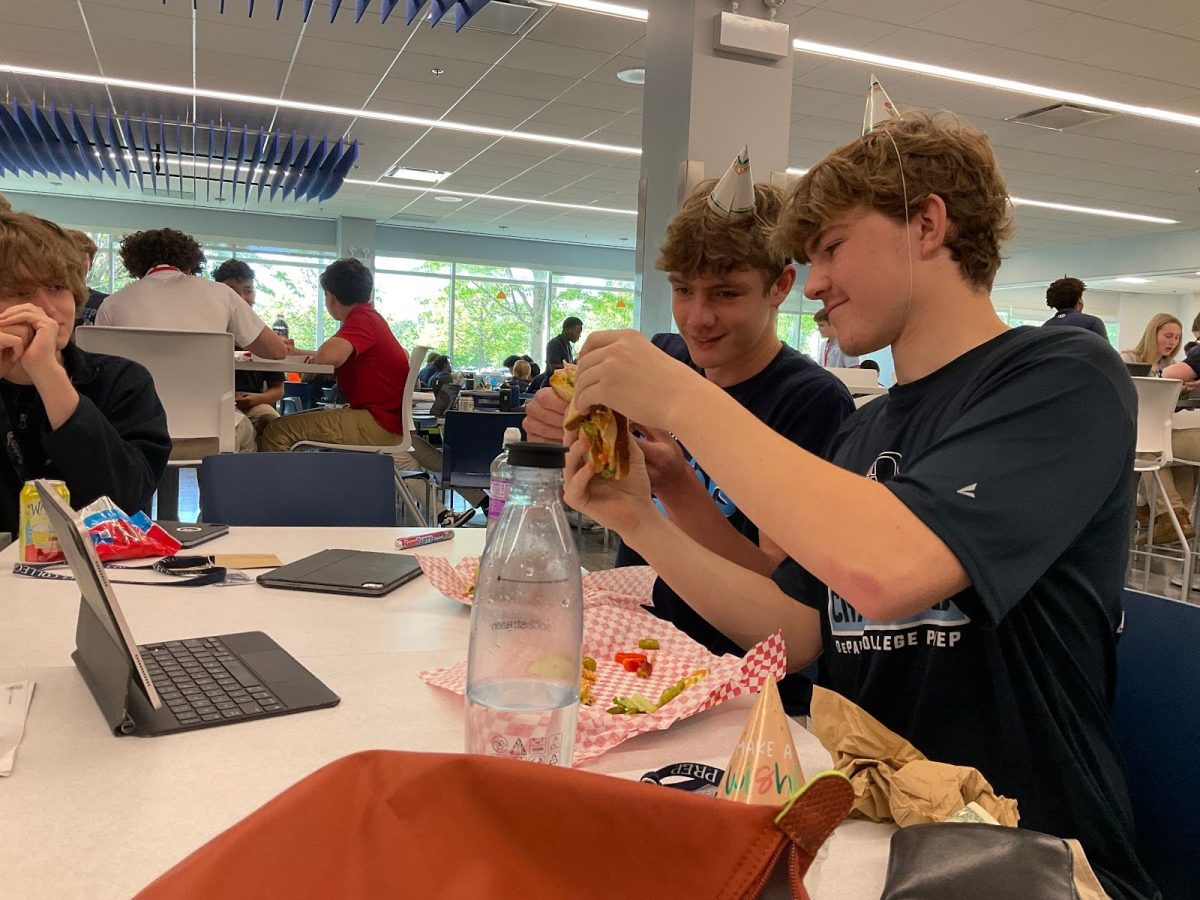

For the past few weeks, many students, staff, and teachers around campus have been wondering “Why are students carrying socks around school?” Often, students can be seen carrying decorated “sock babies” complete with googly eyes, a blanket, hats, and drawn-on faces. Many may wonder, what class could this be for, and how could this possibly be educational?
In unit three of A.P. Psychology, students learn about the developmental process and stages that babies and adolescents go through. Babies often seem unaware of the world around them, but in reality they are often taking in and processing every bit of information they come across. The way that babies come to understand the world around them is often sorted into stages, as they tackle new problems and grow. According to famous psychologist Eric Erickson, at different stages of life children face different problems that they must overcome to be successful. In addition to theories around the development of children’s brains, A.P. Psychology also covers how the environments a baby is put in impact their life.
DePaul Prep’s Psychology teacher Megan McCabe said, “The psychology behind it is to give kids a more tangible understanding of how much a baby develops and also how much of what a baby is exposed to influences their environment.”
Students use their sock babies to grasp these concepts and in a way, apply them to their own “baby” through activities surrounding parenting, childhood temperament, and other psychological influences that occur at that age.
However, despite the reasoning for the activity, some may find it odd that students are expected to carry their sock babies around the school every day.
These people may be surprised to know that, according to McCabe, “This activity is really popular nationwide. Some people do varying degrees of it. People use eggs, and the kids have to try not to crack them. Others make kids buy baby dolls and carry the baby dolls around with them. At DePaul Prep, we use socks.”
The sock babies create a fun and memorable way for students to learn material surrounding the development of children from birth to adolescence, and also bring attention to the A.P. Psychology course which encourages more students to enroll in it.
In all, the “sock baby” experiment is a fun way to teach students about how babies develop over the course of about two weeks. Students can have fun taking pictures with their sock babies and posting them online, while also understanding their A.P. Psychology class is better. Although the sock baby activities and experiments are now over, they will surely be back next year and source more questions, curiosity and excitement surrounding what they are and what their purpose is!